
University Presentation Showcase: Undergraduate Poster Gallery
Preview
Creation Date
2025
Major
Psychology
Department
Psychology
Degree
Undergraduate
Mentor
Olivia A. Williams
Mentor Department
Psychology
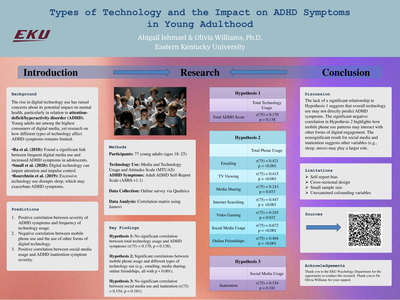
Abstract
The widespread use of digital technology has raised concerns about its potential impact on mental health, particularly in relation to attention-deficit/hyperactivity disorder (ADHD). Young adults are among the highest consumers of digital media, yet research on how different types of technology use affect ADHD symptoms remains limited. This study examined the relationship between technology usage and ADHD symptoms in young adults (ages 18-25). Participants (N = 77) completed the Media and Technology Usage and Attitudes Scale (MTUAS) and the Adult ADHD Self-Report Scale (ASRS-v1.1). Correlation and regression analyses were conducted to assess the associations between total technology usage, specific types of technology, and ADHD symptom severity. Results indicated no significant correlation between overall technology usage and ADHD symptoms (p = .138). However, increased mobile phone usage was significantly associated with various types of digital engagement, including emailing (p < .001), TV viewing (p = .043), and online friendships (p < .001). Additionally, social media use showed a weak but non-significant relationship with inattention symptoms (p = .094). These findings suggest that while general technology use may not directly predict ADHD symptoms, specific digital behaviors—such as excessive phone use—could be linked to attentional difficulties. Further research is needed to explore potential causal relationships and the role of other contributing factors, such as sleep and multitasking.