
University Presentation Showcase: Undergraduate Poster Gallery
Preview
Creation Date
2025
Major
Wildlife Management
Department
Biological Sciences
Degree
Undergraduate
Mentor
Amy Braccia
Mentor Department
Biological Sciences
Abstract
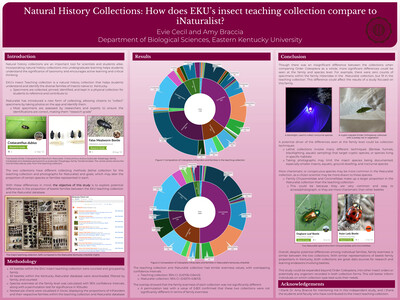
Natural history collections are important tools for scientists and students alike. Incorporating natural history collections into undergraduate learning helps students understand the importance of taxonomy and encourages active learning and critical thinking. However, with decreased funding for natural history collections and a rise in digital collections like iNaturalist, this study aims to compare the differences in composition within both collections and how they may be utilized in research projects. This study specifically looks at beetle family composition between EKU’s insect teaching collection and iNaturalist’s Kentucky database. Counts of beetles in each family were taken, along with total counts for each collection. Family evenness was conducted using Pielou’s evenness index in RStudio, with a permutation test to determine the difference between the two collections. Results were visualized in Excel, with pie charts of selected groups of beetles. No significant difference in family evenness was found between the teaching collection (M = 0.76, 95% CI [0.671, 0.844]) and iNaturalist (M = 0.73, 95% CI [0.657, 0.801]), but larger differences appear among smaller groups of beetles (infraorders and suborders). Both collections have biases, including collection methodology (lethal collecting or photographs). Considering the results of this study, along with collection biases and the specific needs of a project, individuals can decide which collection best suits their project, and better understand where significant differences in collection data lie. Overall, both collections have pros and cons, but both are great data resources, depending on the taxonomic level and scope of a study.