-

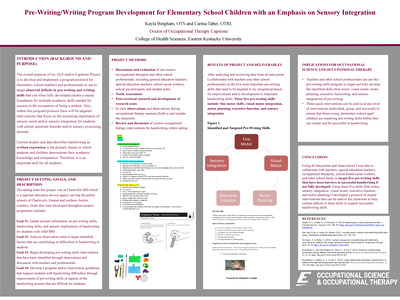
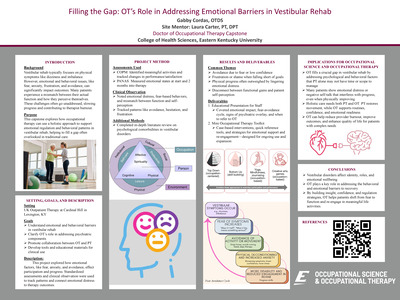
Occupational Therapy's Role in Work and Industry: Manufacturing
Madeline Spears
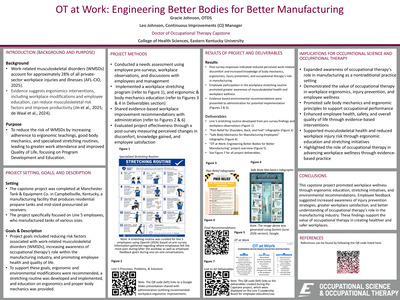
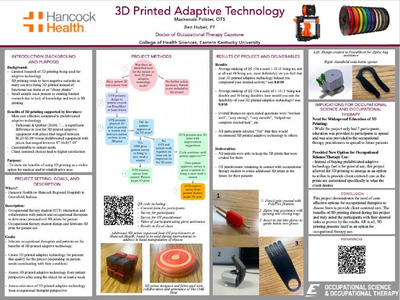
This capstone project focuses on the role of occupational therapy in a work and industry setting. I completed this capstone in collaboration with the manufacturing engineering program at EKU and leaders from Toyota Powertrain with the overarching goal being to increase accessibility and advocate for expansion of the manufacturing workforce to include workers with disabilities. Toyota provided assembly parts for their cam housing process with the objective to adapt the process to be accessible for wheelchair users. I completed a thorough task analysis followed by collaboration with engineering professionals to design and build a new manufacturing workstation that is wheelchair accessible and applies principles of universal design to optimize accessibility and ergonomics. This workstation is a proof of concept that was provided to Toyota to demonstrate how someone who requires wheeled mobility can complete the same job tasks. Additionally, I developed and provided learning modules for manufacturing engineering students to educate them about physical disabilities and inclusivity. Occupational therapists are well-suited to take on an active role in work and industry and possess unique value in manufacturing as a consultant for injury prevention and health maintenance.
-
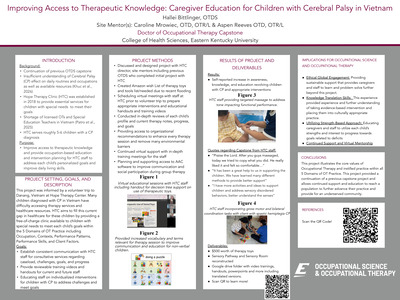
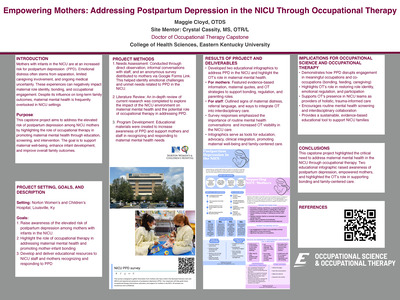
Prenatal and Postnatal Experience Focusing on Women’s Mental and Physical Health
Karen Stamper
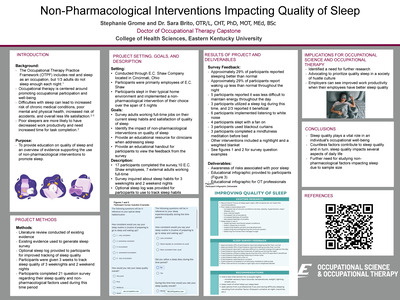
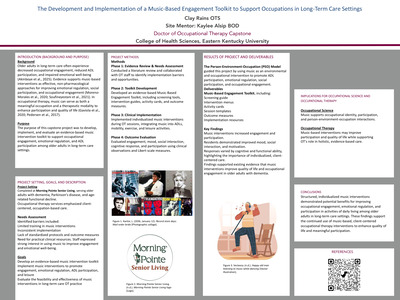
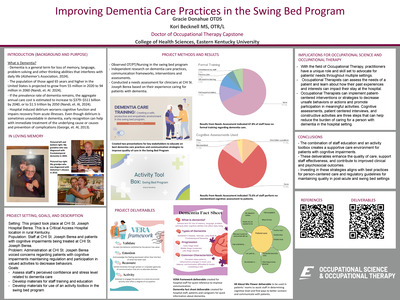
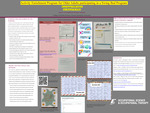
This capstone experience was about creating an activity enrichment program for the hospital's swing bed program. This program can easily be transferred to other areas as need be but for this experience it was directed towards an inpatient rehab swing bed program. For the creation of the program data collection was used, a total of three assessments were utilized, the SLUMS a cognitive assessment, the geriatric depression scale to measure depression levels, and an activity interest checklist was used to gather information on meaningful activities that those participating enjoyed. Once data collection was finished, a continued literature search was conducted combining research and literature to find evidence-based activities that were enriching for patients to participate in. Twelve months of activity calendars were created, and activity analysis was used to break down each activity into instructions and materials lists. A google drive was created for the enrichment program divided by month. An about me sheet was also created to give additional information about meaning activities of the patients to use for the program. A QR code was created for patients to scan when they are ready to discharge home to give the hospital data related to this newly created enrichment program. This QR code will be available once the enrichment program is implemented. An infographic explaining the importance of enriching activities was also created to educate staff and can be easily handed out in a staff meeting or in-service. A physical copy of the program printed in binders and digital copy on a google drive was given to the therapy department upon completion of this capstone experience for the hospital to begin implementing this program on their swing bed unit.
-
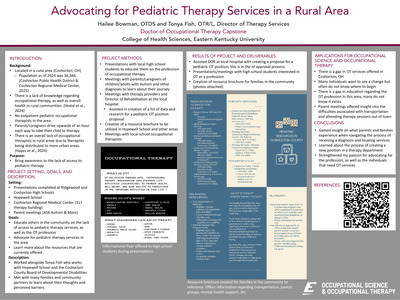
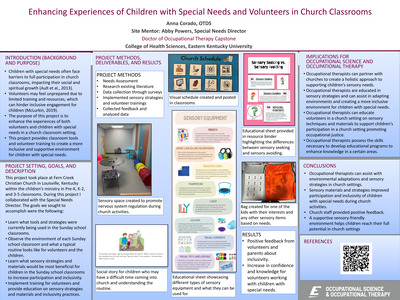
Accessible Shores: Promoting Beach Accessibility in Florida
Sara Swartz
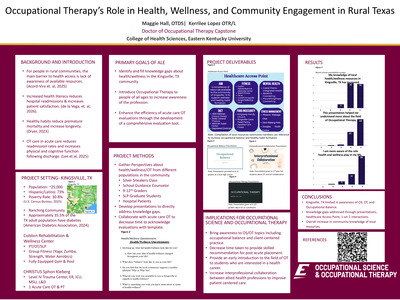
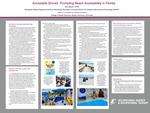
This research experience sought to improve beach accessibility for members of the community facing barriers to occupational participation. Beach accessibility is essential for creating meaningful experiences and improving well-being through exposure to blue spaces. Despite its benefits, numerous environmental and systemic barriers hinder individuals with disabilities from safely accessing spaces. To further research this issue and challenges to participation, survey responses from community members of Jacksonville, Florida were gathered and analyzed for common themes. Conversations with professionals in the area allowed for greater insight on available resources and assistive device technology that could improve beach accessibility. To showcase this information and provide a positive experience, an accessibility event was coordinated to include affected members of the community, hosted by vendors who could provide assistive devices and resources to shed light on what is available to improve their experience in blue areas. A number of vendors, such as SportsAbility, provided all-terrain wheelchairs and resources that event attendees could try in order to see how they may use this equipment in the future. Through this experience, I came to the realization that environmental barriers did not solely represent barriers individuals may face, as man-made barriers posed significant issues regarding funding, adequate staffing, and supportive policies put in place to be inclusive of beach use for all. As occupational therapists, there is a recognized need for advocacy and spreading awareness of existing resources to help others participate in this valuable occupation.
-
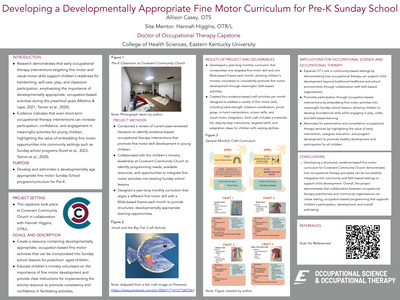
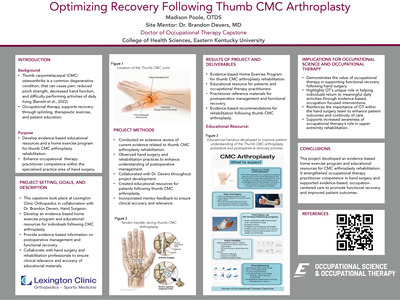
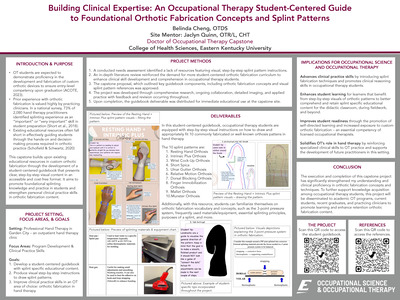
A Conservative Treatment Protocol for Thumb Carpometacarpal Osteoarthritis
Adam Waggener
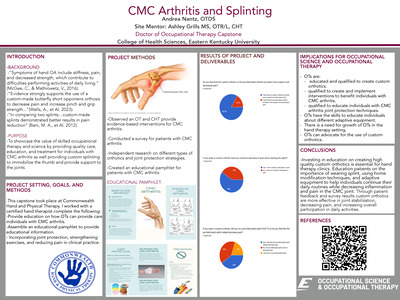
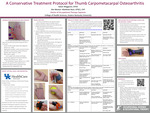
This capstone project sought to construct a written conservative treatment protocol for thumb CMC OA, emphasizing evidence-based practices. As a hopeful hand therapist, clinical observations led me to realize thumb CMC OA was a common condition present in many cases. A written protocol would be beneficial to both client and practitioner to increase knowledge and awareness of best practice while educating clients as they seek treatment. Initial development of the protocol included communication with current hand therapists to better understand needs of both client and practitioner. Following this, a thorough analysis of current literature was completed for best evidence based practices. Evidence and feedback provided was incorporated together to ensure protocol was meeting needs of both practitioner and clients. Within the protocol, supplemental education was provided to include evidence-based exercises and resources such as a patient handout to improve education of condition and adherence to protocol. Conserving function being a key goal to improve overall long-term outcomes and lessen the likelihood of needing surgery in the future. This protocol provides succinct but thorough information that is universally helpful to both new and experienced therapists and students like myself, seeking to pursue hand therapy in the future. To continue fostering success within the community, more thorough protocol documentation is needed to develop plans of care and protocols, contributing to the success of the OT community at-large.
Printing is not supported at the primary Gallery Thumbnail page. Please first navigate to a specific Image before printing.